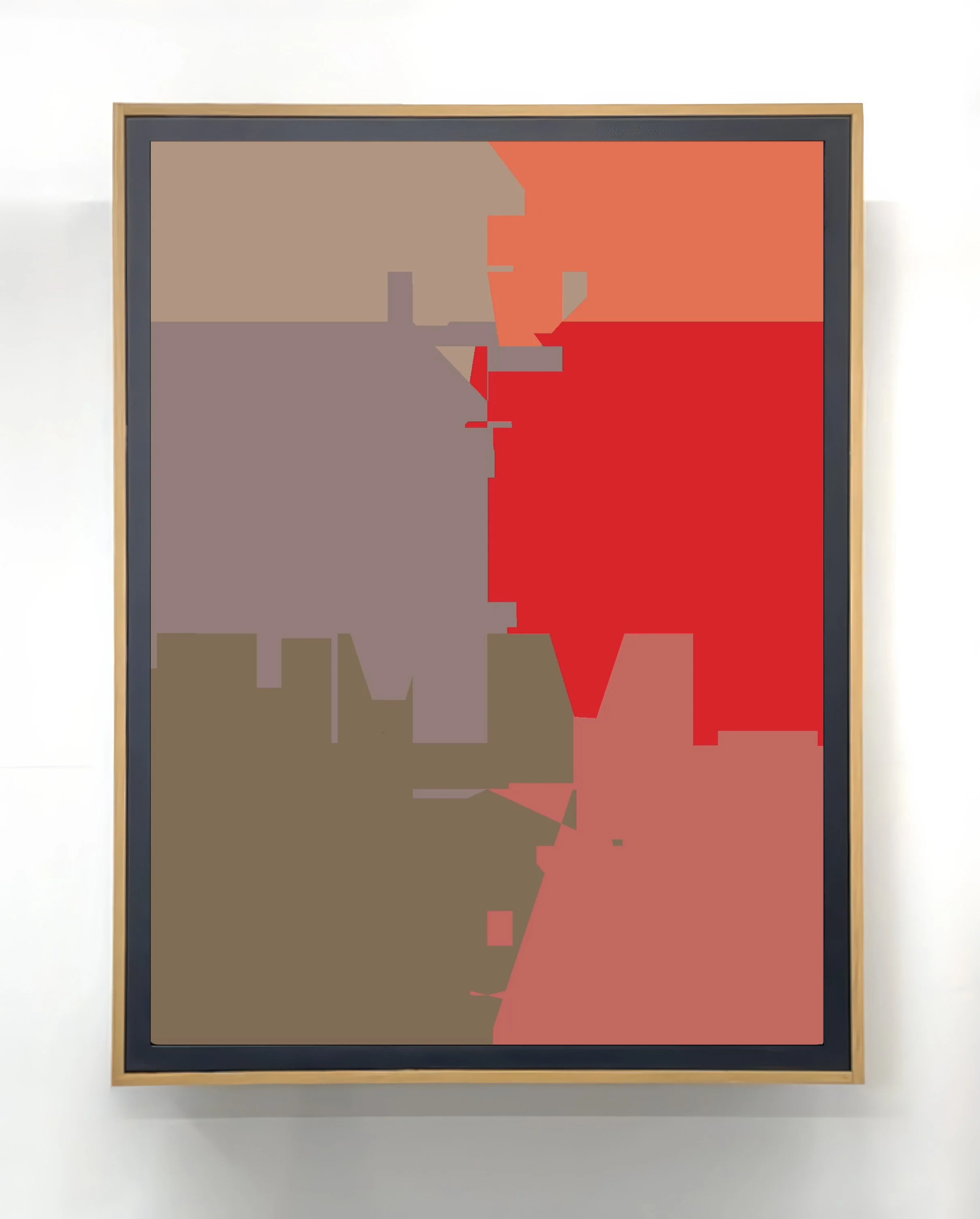
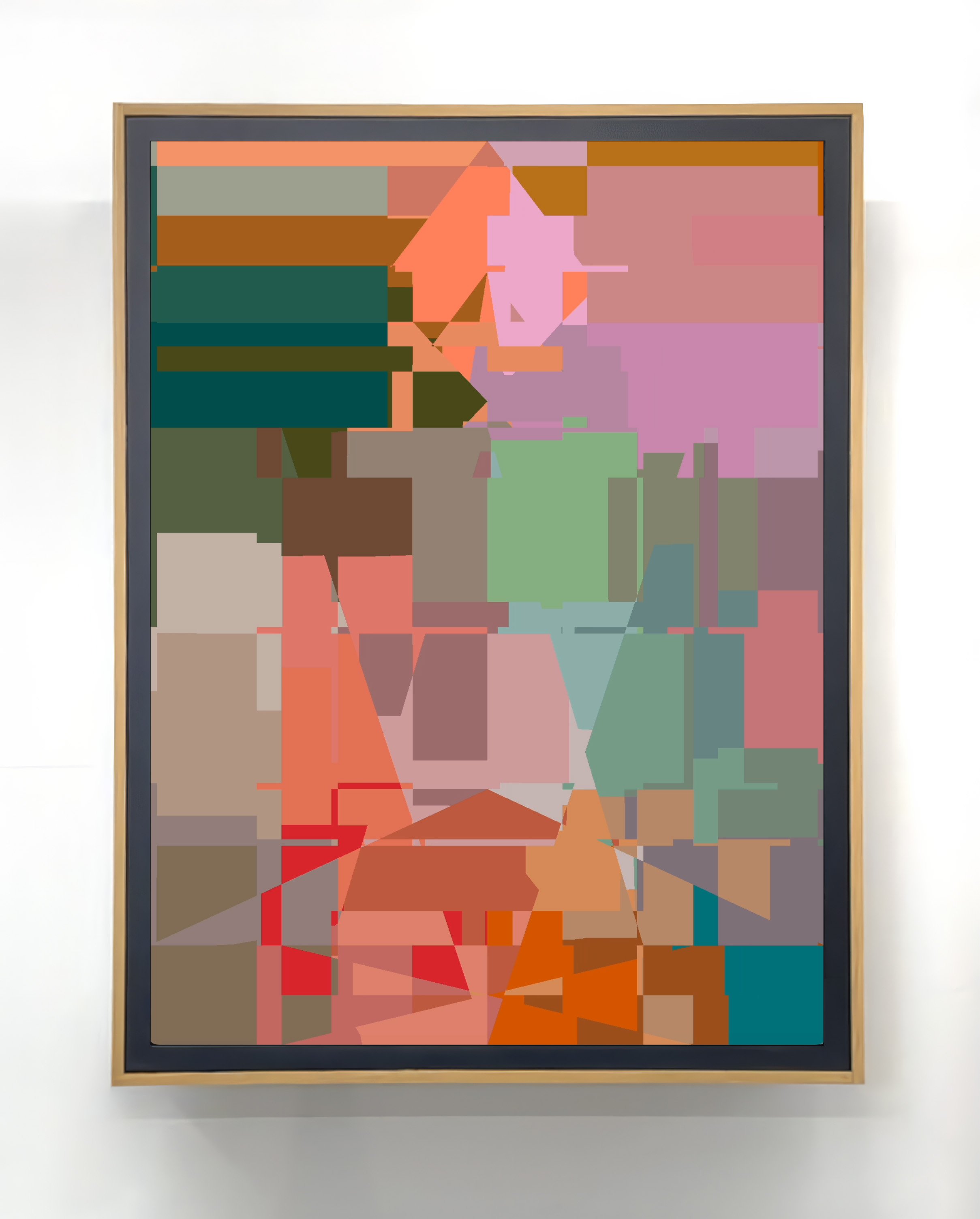
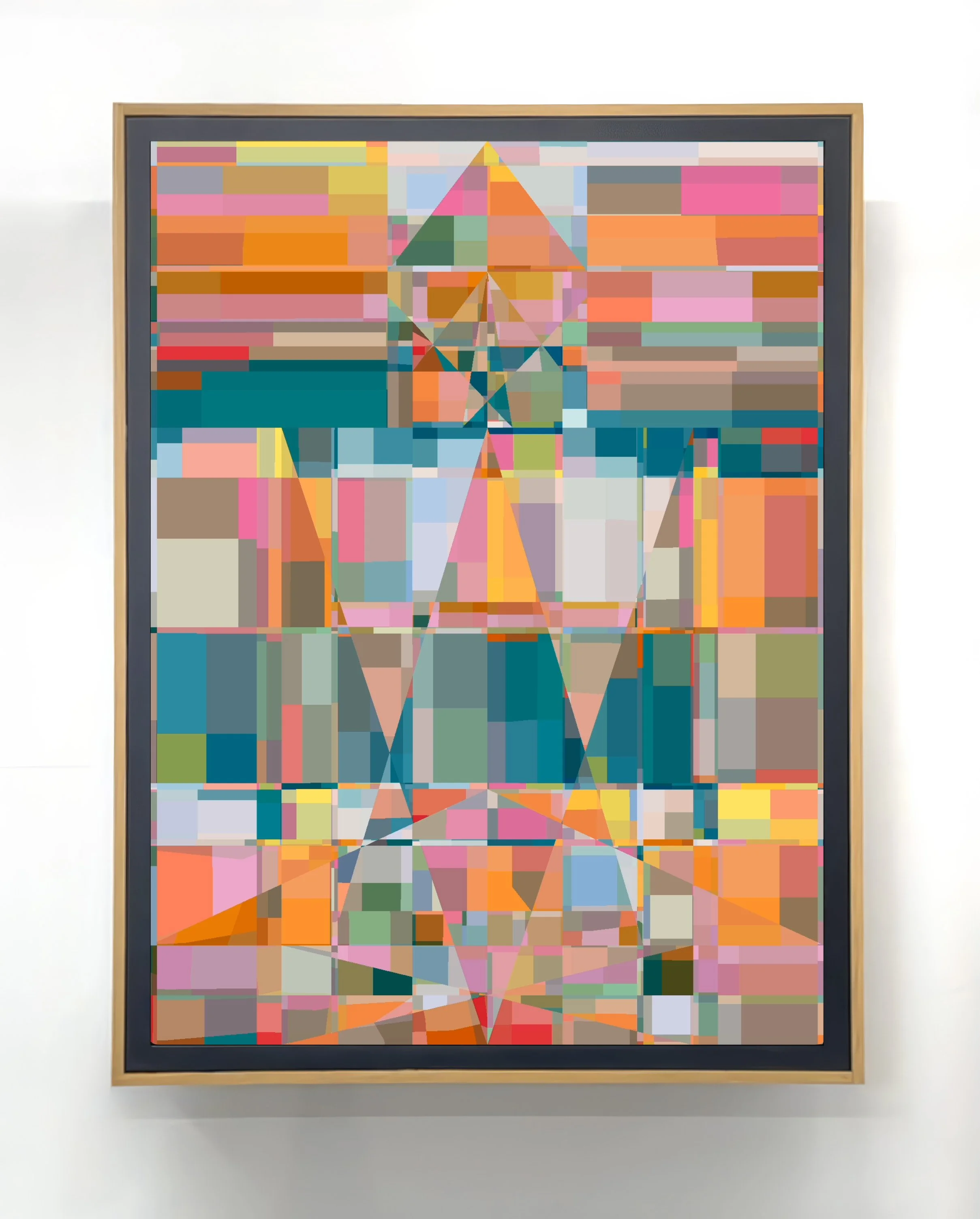
The One Gone Beyond: Watching Thoughts (2025)
The One Gone Beyond: Watching Thoughts, 2025
20” x 25”
Custom software, computer, screen, oak frame
The One Gone Beyond: Watching Thoughts conveys the process of analytical meditation—a lesser-known type of meditation in which one welcomes thoughts, rather than chasing them away. The piece begins with a pure color field and then complicates through the underlying geometry of Shakyamuni Buddha (the historical Buddha who lived 2500 years ago). Colors slide in at different speeds and scales, much as thoughts pile one atop the other in our minds, eventually dissolving again into a single color field like the open, spacious mind. The piece continues in new cycles of 6 minutes, echoing short meditation sessions in the Tibetan tradition that differ with each cycle until repeating 2 hours, the duration of a typical meditation retreat session. Echos of the early 20th century abstractions of Mondrian, Klee, and Kandinsky are deliberate, honoring prior Western abstract artists who explored the connection between spirituality, color, and abstraction.
About the Hidden Geometries Series
The One Gone Beyond: Watching Thoughts is part of the Hidden Geometries series, based on the grids that Himalayan painters have used for centuries. I learned these techniques over the past 24 years from master Tibetan and Nepalese thangka artists in Nepal and the San Francisco Bay Area.
Like other works in the series, this one is inspired by the long South Asian lineage of devotional art. Unlike much Western art, which often emphasizes cultural, aesthetic, or intellectual content, devotional art seeks to induce a direct inner experience. My work continue that tradition, aiming to evoke specific meditative states in the viewer.
The thangka paintings upon which these works are based are part of Tibetan Buddhism’s Vajrayana tradition. In this form of Buddhism, we understand both these archetypes of enlightenment and ourselves to be comprised of three “bodies”: our physical body, our mind, and an energetic body that bridges them. We experience this energetic body that translates mind to matter when we speak, dance, exercise, play music—and make art.
In tantric visualization practice, the archetype one imagines relates to this energetic body, embodying qualities like love, compassion, wisdom, and power. Its form arises in meditation from a field of infinite light and clarity, into which it eventually dissolves. I echo that process in each artwork’s evolution: emerging from a single color field into which it eventually dissolves.
Technically, each software art piece is executed as custom computer software written by the artist that is rendered in real time on a small computer mounted on the back of the display. It filters a low-resolution image of a traditional thangka painting through the sacred geometry of the particular archetype. These cycles are not video loops, but continuous algorithmic renderings translated through the “mind” of the computer.